


Our contribution to the 2030 Agenda


What are the global goals?
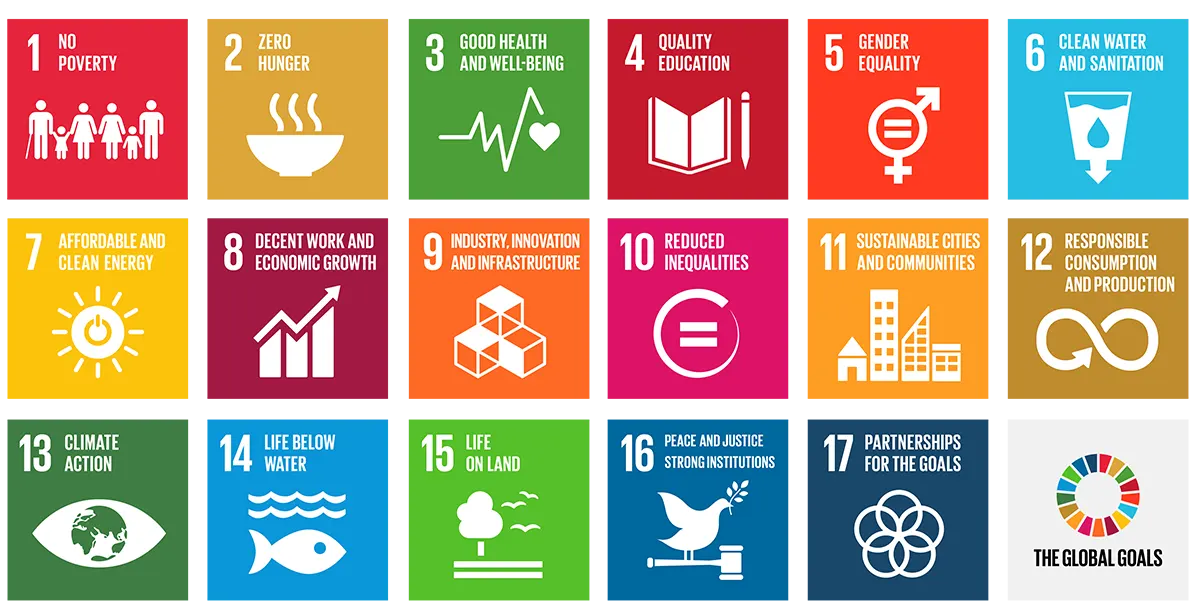
The Global Goals, also known as the Sustainable Development Goals (SDGs), are a set of 17 ambitious targets established by the United Nations to address some of the most pressing challenges facing the world by 2030. These goals were adopted in September 2015 by all 193 United Nations Member States at the United Nations General Assembly.
The primary objective of the Global Goals is to improve the quality of life of people around the world by promoting environmental sustainability, economic prosperity, social justice, and peace. The SDGs encompass a wide range of issues, including poverty, hunger, health, education, gender equality, access to clean water, peace and justice, the health of the planet, and many others.
Implementing the SDGs requires a collective global commitment, involving governments, international organizations, the private sector, civil society, and citizens. The idea is to create a more equitable, sustainable, and inclusive world, where no one is left behind.
By continuously monitoring progress toward these goals and promoting concrete actions at the local and global levels, the Global Goals serve as a guide to direct collective efforts toward a more prosperous, just, and environmentally sustainable future for all.
Gender equality and human capital valorization
In 2025, we obtained certification according to UNI/PdR 125:2022, adopting a Gender Equality Management System aimed at monitoring and improving our performance over time in terms of equity, inclusion, and personal development. Through this system, we collect and analyze data relating to the composition of the company’s population, identify any gaps, and define targeted actions to overcome them, with a view to continuous improvement and transparency.
Clean and accessible energy
In 2021, the complex whey recovery plant, the main by-product of the dairy industry, became fully operational. The whey is concentrated internally and used to produce biogas, which in turn generates 37% of the electricity and 6% of the thermal energy needed by the dairy. In 2023, we activated a 400.4 kW photovoltaic system, allowing us to meet approximately 9% of our residual electricity needs through renewable sources (2025 data).
Responsible consumption and production
Since 2024, we have redesigned the packaging for sachets and sachets, reducing the annual plastic consumption of this primary packaging by 36%. We have replaced secondary polystyrene packaging with cardboard packaging. Since 2021, we have reduced water withdrawals from the network by 8% each year, using water produced by the whey concentration process for daily cleaning of the systems. 100% of our waste is recycled (2025 data).
This material is not endorsed by the United Nations. The content expresses the views of Centrale del Latte del Molise and does not imply any official endorsement or affiliation with the United Nations or its Sustainable Development Goals.